
Per capita income has more than doubled to Rs 1.97 lakh in around nine years. Indian economy has increased in size from being 10th to 5th largest in the world in the past nine years. Seven priorities of the Budget, 'Saptarishi', are inclusive development, reaching the last mile, infrastructure and investment, unleashing the potential, green growth, youth power and financial sector.

Three policymakers aware of the central bank's deliberations on the Budget said they are combing through the numbers to test how Jaitley struck a balance, and question some of the assumptions.

Fiscal deficit planned to reduce to 4.8 per cent in FY2014, subsidy bill remains elevated. Proposes to reduce fiscal deficit to 3%, the revenue deficit to 1.5 per cent and the effective revenue deficit to zero by FY2017.

An official said the government is preparing the financial statements and getting the data room ready for the sales, suggesting that such aspects take time.

Union Finance Minister Nirmala Sitharaman, along with her team of bureaucrats, delved into the fine print of the 2024-25 Budget documents in a press conference, detailing the government's road map on bringing down the debt-to-GDP ratio and bold tax measures.

A continued focus on low inflation will be important to keeping gold imports, IMF said.

The World Bank on Tuesday revised upwards its GDP growth forecast for India to 6.9 per cent for 2022-23, from 6.5 per cent earlier.

China is battling a property downturn, industrial overcapacity, sluggish demand and struggling exports.
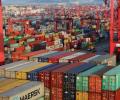
US President-elect Donald Trump's pledge to impose high tariffs on three of its trading partners, including China will provide huge export opportunities for India and the domestic industry should prepare itself to tap into that, Niti Aayog CEO BVR Subrahmanyam said on Wednesday. Trump last week vowed to introduce 25 per cent tariffs (or customs duty) on imports from Mexico and Canada and an additional 10 per cent on China.

The new government that presents the full Budget for 2024-2025 in July should be ready to restructure the way divestment is managed and implemented, proposes A K Bhattacharya.

Could it have been more reformist? Of course, but this is an election year Budget, observes Akash Prakash.

The government on Friday sought Parliament's nod for an additional Rs 54,000-crore spending mainly to meet its obligation towards GST compensation to states and defence-related expenditure. Minister of State for Finance Anurag Thakur presented the second and final batch of supplementary demands for grants in the Lok Sabha.

While most experts suggest the government loosen its purse strings and not worry about the fiscal deficit in a pandemic impacted year, it will be a tightrope walk for the government to increase spending without going overboard.

India's merchandise exports in June increased 2.56 per cent to $35.2 billion from $34.32 billion in the year-ago month, according to government data released on Monday. Imports rose by about 5 per cent to $56.18 billion in June against $53.51 billion a year ago.

India's budget for the fiscal beginning April focuses on giving a boost to the ongoing economic recovery through a sharp increase in capex spending but is short on major growth-enhancing structural reform announcements, Fitch Ratings said Wednesday. The deficit targets present in the Union budget 2022-23 by Finance Minister Nirmala Sitharaman on Tuesday "are a bit higher than our forecasts when we affirmed India's 'BBB'/Negative sovereign rating in November," said Jeremy Zook, director and primary sovereign analyst for India, Fitch Ratings. While it was widely expected that the fiscal deficit will be lower than the targeted 6.8 per cent of the GDP in the current fiscal year ending March 31, 2022, Sitharaman put the number at 6.9 per cent.

The moves on basic income for farmers - Rs 6,000 per person in three installments per annum - and subsidised agricultural loans are likely to boost the rural economy through consumption in the near-term, but will have a fiscal cost, it noted.
Let's wait for the monetary policy on February 8 -- to see how it complements the fiscal commitments, points out Tamal Bandyopadhyay.

>According to the latest RBI data, PPF receipts have already experienced a decline between April 2023 and February 2024. Other schemes like the Sukanya Samriddhi Account and National Savings Certificate are also witnessing reduced inflows.
The BJP-led National Democratic Alliance's (NDA) slim majority in Lok Sabha may delay more far-reaching economic and fiscal reforms that could impede progress on fiscal consolidation, Moody's Ratings said on Wednesday. NDA securing a majority in the general elections will give a historic third term for Narendra Modi as Prime Minister of India. "We expect policy continuity, especially with regards to budgetary emphasis on infrastructure spending and boosting domestic manufacturing, to support robust economic growth.

The implication of a slowdown in the financial services sector are very different (eg, likely to affect fewer people directly, and even that affecting those at the top of the income distribution) from that of a slowdown in construction, one of the most employment intensive sectors in the Indian economy (that will affect aggregate demand much more).'

The government can issue recapitalisation bonds, or the RBI's huge reserves of over $127 can also be dipped into to help the state-owned bank's recapitalisation needs.

Ahead of the 2023-24 Union Budget, the thinking at the top level of the central government is clear: Gross domestic product (GDP) growth of 6-6.5 per cent is a comfortable enough target for FY24 and the focus should be on fiscal consolidation to ensure that the sovereign cost of borrowing does not become prohibitively expensive in a high-interest rate environment, according to people in the know. Those aware of deliberations between the Prime Minister's Office (PMO) and the Ministry of Finance said while the Budget would look to strike a balance between infrastructure investment and welfare schemes, it is unlikely to be populist, though it will be the last full-year Budget before the 2024 Lok Sabha election. Incidentally, 6-6.5 per cent GDP growth is what the upcoming 2022-23 Economic Survey is expected to project for FY24.

The government will borrow Rs 5.03 lakh crore in the second half of the current fiscal to fund the revenue gap for reviving the pandemic-hit economy, the finance ministry said on Monday. During the first half, the government has raised Rs 7.02 lakh crore by issuing bonds, the ministry said in a statement. "Out of gross market borrowing of Rs 12.05 lakh crore projected for FY 2021-22 in the Union Budget, Rs 7.24 lakh crore (60 per cent) was planned to be borrowed in first half (H1).

Enhanced revenue generation is a priority for the government.
The government on Tuesday said the decision to repay pre-maturely two-dozen high cost ADB and World Bank loans totalling $2.8 billion will not impact fiscal deficit and the repayment would be done from February 15 to 18 this year.

Fiscal pressure for the Indian economy is gradually rising, suggested analysts at Jefferies in a recent note, as oil prices (Brent) - which are close to the $100 a barrel mark - continue to climb ahead of a busy election calendar. They added that the sharp rally in the equity markets during the last few months has made valuations costly. As a result, Jefferies expects the Indian markets to remain choppy in the near term.

Moody's Investors Service on Friday affirmed India's rating at the lowest investment grade of 'Baa3', with a stable outlook, saying high growth will support a gradual increase in income levels, but flagged risks of populist policies due to rise in political tensions. Moody's said although India's potential growth has come down in the past 7-10 years, the growth would outpace all other G20 economies through at least the next two years, driven by domestic demand. Moody's said the restoration of robust growth prospects post-pandemic, the effective commitment to inflation targeting and the rehabilitation of the financial system aided by reform supports its view of strengthening monetary and macro policy effectiveness.

'There is no immediate threat to the government, and they would prefer the growth agenda.'

Looking under the hood, I see India on the terrible, but commonplace, road to prosperity failure, warns Rathin Roy.
The industrial output for the third month in a row remained in the negative territory, contracting 1.5% in January
Global private equity major KKR has ranked India second among the emerging markets on external risks, citing the high fiscal and current account deficits.

'Investors looking at the next 6-12 months can be certain that the Fed will maintain its easing cycle, and we expect the overall environment to be conducive for fixed income investments for portfolio diversification.'

It pointed out that farm loan waivers, combined with a potential stimulus which the government is mulling now, can result in a 1 percentage point slippage in fiscal deficit

India's merchandise exports in October rose by 17.25 per cent to $39.2 billion against $33.43 billion a year ago, according to government data released on Thursday. Imports increased by 3.9 per cent to $66.34 billion in October compared to $63.86 billion in the year-ago period.

Despite crude comfort, heavy spending cuts needed to offset Rs 80k-cr revenue shortfall

RBI awaits fiscal stance, inflation to cool off to decide on rates.

The size of Budget 2024-25 has increased 6.1 per cent to Rs 47.66 lakh crore because of the rise in expenditure and higher allocation for capital expenditure and social sector schemes.

Retail inflation crossed the RBI's comfort level and rose to 5.21 per cent in December on increase in prices of food items.

Three years after India declared its goal to become a net-zero economy by 2070, the policy design for achieving the target has begun, with the NITI Aayog forming dedicated multi-sectoral committees to prepare a transition plan. In 2021, India joined a select group of nations that set a target year for becoming net-zero carbon economy. At COP26 in Glasgow, Prime Minister Narendra Modi outlined a five-pronged 'Panchamitra' climate action target for India and committed to a net-zero target by 2070, joining nations like the US, the UK, and China.

The country's gross domestic product (GDP) growth is likely to be 8.8 to 9 per cent in the current financial year, driven by agriculture and industry sectors, Care Ratings said in a report. The country's economy had contracted by 7.3 per cent in fiscal 2020-21. The agency said the outlook for the Indian economy on almost all counts in FY22 would look seemingly better than FY21 on account of the negative base effect.
